
Sustainable Caring
Care deeply. Sustain yourself.
A practical, facilitated experience that helps people in high-demand workplaces recognize burnout, compassion fatigue, and change fatigue earlier, then respond in ways that protect both humanity and performance.
Notice. Release. Restore.
The goal is not to ask people to care less. It is to help them care without disappearing in the process.
The human cost of high-demand work
Sometimes the people who care the most carry the most.
In healthcare, social services, education, nonprofit work, public service, and other high-pressure environments, people are often asked to absorb more, adapt faster, and keep showing up for others.
Over time, the emotional weight of the work can affect patience, communication, decision-making, connection, and the capacity to care. Sustainable Caring creates language for what people may be experiencing and practical ways to respond before strain becomes disconnection.
The work is not to become less caring. The work is to build a way of caring that does not require your disappearance.
Tools that travel with them
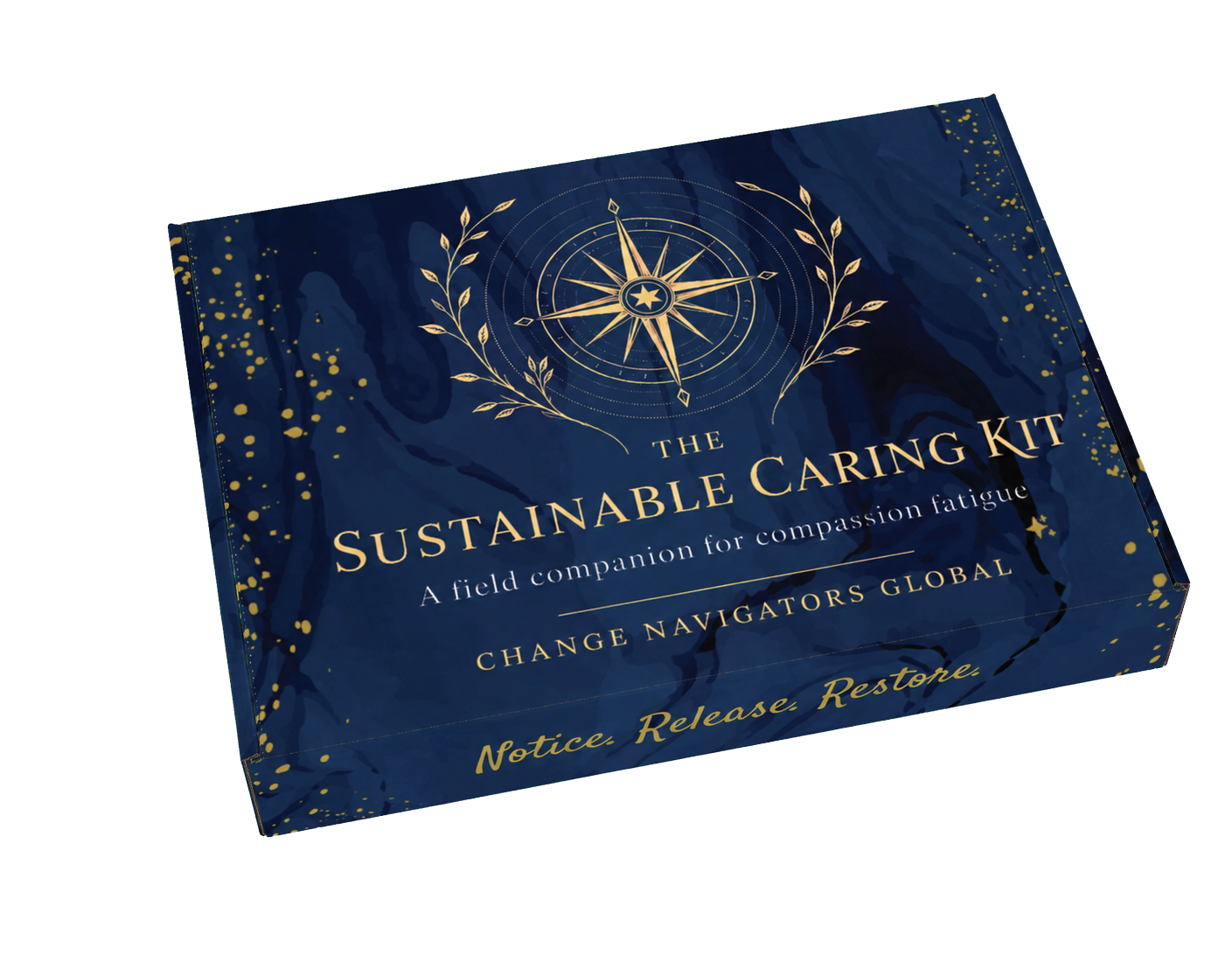
The Sustainable Caring Kit
Participants leave with thoughtfully designed resources that extend reflection and application beyond the facilitated experience.
Field Manual
A guided companion for reflection and practical application.
Activation Cards
Prompts that support Notice, Release, and Restore.
Fatigue Guide
A practical distinction between burnout and compassion fatigue.
Reset Tools
Small practices to use during and after demanding work.
Physical participant kits are included with the 2-hour and half-day in-person experiences. Kits may be added to keynote or virtual engagements for an additional fee.
Not all fatigue is the same
Recognizing the difference changes the response.
Burnout, compassion fatigue, and change fatigue can overlap, but they do not always begin in the same place or require the same kind of support.
01 | Workload
Burnout
Often develops through chronic workload, insufficient recovery, limited control, unclear expectations, or prolonged organizational pressure.
02 | Emotional exposure
Compassion Fatigue
Can emerge from repeated exposure to the pain, trauma, distress, or urgent needs of others, gradually affecting empathy and emotional capacity.
03 | Continuous disruption
Change Fatigue
Builds when people experience wave after wave of change without enough clarity, involvement, capacity, reinforcement, or time to stabilize.
Burnout is often about what the work demands from you. Compassion fatigue is about what the work leaves inside you.
The experience
Insight that becomes something people can use.
An engaging learning and reflection experience, not a clinical intervention, that gives participants practical language, tools, and small actions they can apply individually and together.
Notice earlier
Recognize behavioral, emotional, physical, and relational signals before they intensify.
Name what is happening
Distinguish burnout, compassion fatigue, and change fatigue without judgment or oversimplification.
Respond practically
Use micro-resets, boundaries, recovery practices, team check-ins, and supportive conversations.
Strengthen the environment
Identify leadership and team practices that make sustainable caring possible beyond the session.
Important: Sustainable Caring is an educational, facilitated learning experience. It is not therapy, clinical diagnosis, crisis support, or a substitute for an organization’s employee-assistance or safety resources.
Who it serves
Built for people and teams carrying demanding work.
Tailored to the language, pressures, and realities of the organization and its workforce.
Healthcare
Nurses, allied health professionals, physicians, support teams, and clinical leaders.
Human Services
Social workers, case managers, counselors, advocates, and nonprofit professionals.
Education
Educators, student-support professionals, administrators, and campus teams.
High-Change Organizations
Leaders and teams navigating sustained pressure, disruption, or transformation.
Ways to engage
Choose the depth that fits the moment.
Every format is adapted to the audience, setting, and organizational context. Final scope and participant capacity are confirmed during engagement design.
Virtual or in person
60-Minute Keynote
A compelling introduction to compassion fatigue, burnout, and the Notice, Release, Restore framework, for conferences, leadership meetings, employee events, and organization-wide learning.
In person | Interactive
2-Hour Experience
An interactive facilitated experience with reflection, discussion, practical application, and the Sustainable Caring participant kit.
In person | Deep dive
Half-Day Experience
A deeper facilitated experience with expanded reflection, application, team dialogue, and the Sustainable Caring participant kit.

Support the people who keep showing up.
Let’s design a Sustainable Caring experience around the realities your people are navigating and the support they need now.